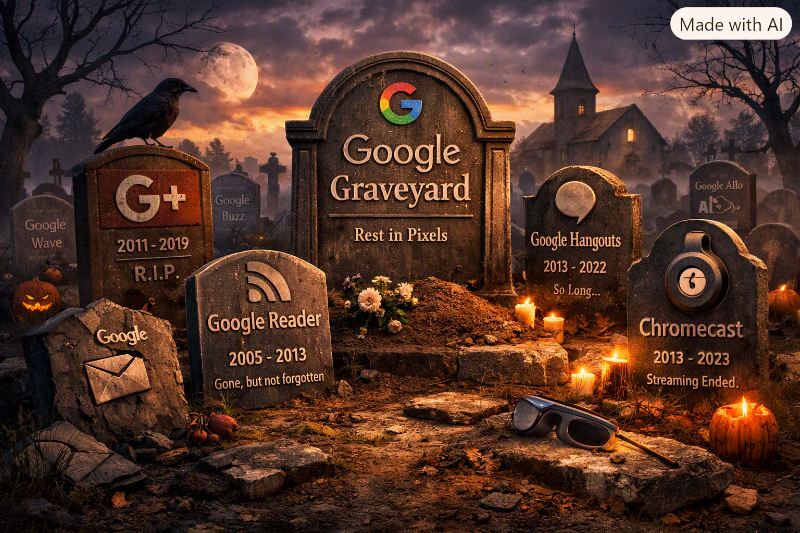
Killed by Google
I recently came across something quite striking—a website called "Killed by Google." It essentially serves as a digital necrology, a ledger of all the apps, services, and hardware that Google has decided to walk away from over the years. It’s a peculiar kind of graveyard, documenting the moments when a piece of technology simply ceases to be relevant to the ecosystem, leaving behind a trail of digital ghosts.
When you look at the list, the sheer scale of this abandonment is a bit unsettling. You see tools like Google Earth Pro, which has been a staple of our digital landscape for decades, now approaching the end of its life after twenty-six years. Then there are the more recent casualties, like the Tenor API, which vanished just a month ago after an eleven-year run, or the Chromecast, which—much like the one sitting forgotten in my own drawer—has been effectively "killed" for about two years now. It is a sobering reminder of how quickly the "cutting edge" becomes "obsolete."
There is a deeper, perhaps more existential, takeaway here. We often look to our technological ecosystems to provide us with a sense of stability and seamlessness, yet this list proves that even the most powerful giants are prone to letting things go. It is a digital illustration of the transience we see everywhere in human experience. It prompts us to ask a difficult question: in a world where even our most sophisticated tools are subject to such sudden abandonment, what is it that is actually built to last?